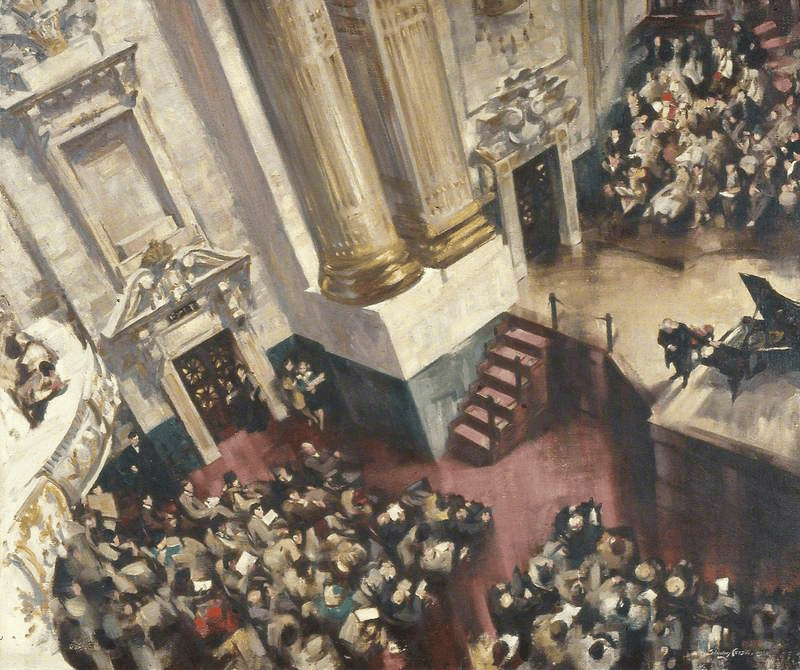
A Manual for Performers
We shall start at the end.
After the final sound of the final encore dissipates, there’s a momentary rift of silence. And then the audience creates something special: heartfelt applause that whirls into the hall like sheets of rain made by soft, appreciative hands. And before he can stand, the audience has lifted to its feet, its ovation growing to a heavy downpour.
Cheers and calls of “Bravo” are heard as he steps towards the front of the stage with a smile and takes his bows.
In the wake of the night’s musical offering, the torrent is relentless.
In response, comes a very rare occurence. I doubt you’ve seen it in your lifetime. Looking out to the crowd he instinctually lifts his hands and gestures with his arms his love and gratitude for his listeners and their triumphant time together. A joyous scene for all.
Afterwards, there’s a gaggle of excitement in the green room, and then a garrulous celebration at the bar and grille across the boulevard—and afterparties still after that. Why not? Everyone’s having a great time.
Now of course, classical music is a noble art. And we musicians don’t practice it for this result—as glorious as it sounds. No, for us, the glory we are after is in the music itself.
But still...what exactly happened to produce this response?
What happened—was the only thing that can produce this response:
He built a bridge to the audience.
He built in so solid a fashion that everyone in the hall trusted it with their hearts.
That bridge was made of phrases.
And phrase after phrase, he delivered on an unspoken promise:
"I will keep my amusement alive."
Now, we shall proceed to the beginning.
There is an electric hum running through the hall as audience members finger through their programs and admire the artist’s handsome new photograph. His eyes flash with a spark and he has a knowing grin.
The reputation of the man is, at this point, institutional. He has visited this great hall since the mature attendees were children. Many starbursts have come and gone, but he has remained a comet the public clamors to see when it makes its round.
The hall grows dark and a shadow enters from stage right into the beam.
It’s him.
Surprisingly, his stocky, well-nourished frame moves eagerly, like an excited tiger on its first hunt.
He meets the applause and faces his audience, standing in front of the instrument for a moment to look out at the sight.
Who knows what memories he has here.
A short bow from the man and he turns to the instrument as a hush sweeps through the space.
Sitting and adjusting to get comfortable, he grabs his lapels with both hands, his posture bolt upright, and seems to confer with his instrument about their evening agenda.
His eyes lower.
His mouth grows curved by desire.
Up and down go his hands.
And out comes a capacious melding of color.
It’s the Barcarolle and you can hear the whole piece in that first chord.
What is this career? What is this reputation? What makes him the genuine article?
It’s so obvious it’s nearly forgotten.
He has simply delivered on his concert promise for half a dozen decades and his stature compounded with interest.
The power of music, for those who know how to wield it, turns a mortal human into a sorcerer, a wizard—capable of conjuring…actual magic.
I tell no lie.
For a person like this man can control the eternal energy that is the universe, and with nothing less than the model of God’s Act of Creation, channel it into emanations of spirit for all those present to witness.
And to cast this spell, he needs only to take a sonata of Beethoven, or a symphony of Tchaikovsky, or what have you, and follow the musician’s motto. Which is:
"I will make music from these notes by being amused with them."
To finish now, we will visit the middle, where the magic happened.
Yes, he built a bridge. It started with that first chord. And by the end of the first phrase he made a pact with his listeners:
"I wish to tell you that though we toil and are beaten by adversity, that life is glorious and I will keep my heart open and listen for glory—and I will inevitably find it, because it is true. Life is Glorious."
By the end of the second phrase, he has begun to keep his word.
By the end of the third, the audience begins to test the strength of his pact, and risk hoping it's true. That Life is Glorious.
Phrase after phrase, piece after piece, the man does not abandon his audience. He stays with them. His word has become his bond and his bond is strong enough now to heal lonely, broken hearts.
The music sounds so good. By Jove, even the slipped notes sound of the music!
My dear musician friends. This is the model after which we strive.
Shared here so you know it well.
Aim high.
Aim for this.
And above all believe.
That Life is Glorious.